How to Plan a 3-Mile Woodland Walk for Beginners
Three miles sounds modest, and it is. On an easy forest track it is roughly an hour and a half of walking, which is why it makes such a good first target for anyone who wants to build a habit rather than tick off a challenge. The trouble is that most disappointing first walks fail for small, boring reasons: a stile the dog cannot manage, a path that is ankle-deep in clay from October to April, or a route described as "about three miles" that turns out to be closer to five. Twenty minutes with a map, a calendar and a pencil prevents nearly all of it.
Measure the Route Before You Walk It
Three miles is just under five kilometres. As a rough rule of thumb, a beginner on woodland paths covers about two miles an hour once you allow for gates, roots, muddy patches and the stopping that happens whenever the wood gets interesting. That puts your walk at around ninety minutes of moving time before you add a break.
Route descriptions are optimistic. "About three miles" can mean 2.6 or 4.2, so trace the line yourself on a paper map or a mapping app and measure it. Aim for a measured 2.5 to 3.2 miles. The distance you actually walk is always a little longer than the drawn line, because you step around fallen branches, give way to other walkers, and take the wrong fork once.
Choose the shape of the route deliberately. A simple loop is ideal. A lollipop — a short there-and-back stem from your parking place to the woods, then a circuit — is better still for a first attempt, because the stem gives you an obvious place to shorten the day. Avoid figure-of-eight routes and multiple loops. It is surprisingly easy to lose count of how many times you have been round.
Match the Terrain to Your Legs
Distance is only half of how hard a walk feels. The other half is what lies underfoot and how much the ground rises.
Look at the contours before you commit. A path that climbs steadily for half a mile will feel considerably longer than the same distance on the flat, and a short, sharp pull of forty or fifty metres is enough to turn a pleasant stroll into a huffing contest if you are new to this. Tightly packed contour lines mean steep ground; widely spaced ones mean gentle ground. Streams, crags and the edges of access land all deserve a second look on the map, too.
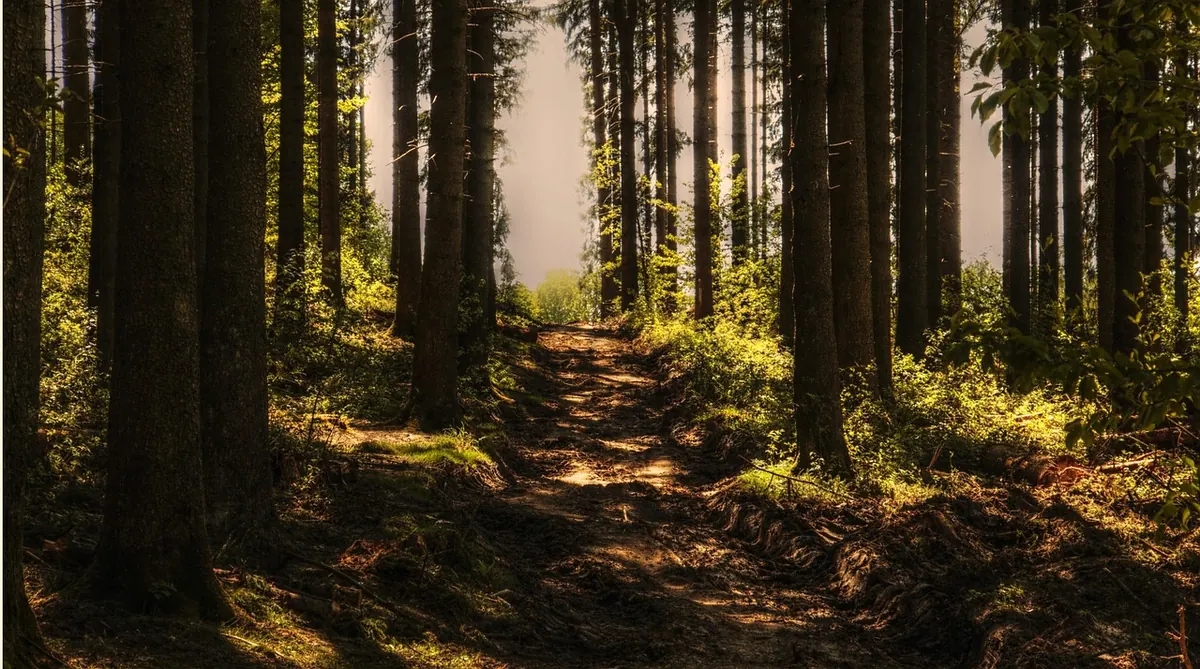
Then think about surface. A wide forest track is easy. A narrow path through oak and hazel can mean roots, mud, a plank bridge, a stile and a kissing gate in the space of two hundred metres. Clay woodland holds water for weeks after rain; sandy pine plantations drain quickly. Check whether the local access authority lists any path closures, and if a section worries you, walk the first half mile and back on a separate afternoon to see what you are letting yourself in for.
Get the Timing Right
Time on your feet
At two miles an hour, three miles is ninety minutes of walking. Plan for two hours and you will not spend the last mile checking your watch. With children, or with a group that likes to stop and look at things, allow two and a half. There is no prize for finishing early, and a walk that ends while everyone still has energy is the one that gets repeated.
Time of day and time of year
Woodland darkens earlier than open ground, and dusk arrives under a canopy while the fields outside are still bright. In winter, a three-mile walk started at half past two in the afternoon finishes in the gloom; either start earlier or carry a small torch. In summer the problems reverse — heat in the middle of the day, bracken narrowing the path, and insects that make standing still unpleasant.
Late autumn to early spring is mud season in most deciduous woods. The route that takes ninety minutes in June can take two hours in February, not because it is longer but because every step needs more thought. Build that into the plan rather than being surprised by it.
Fix Your Turnaround Point in Advance
Every first walk should have a decision point: a gate, a bridge, a bench, a track junction where you have already agreed what happens next. Choose it at home, with the map open and a cup of tea to hand, rather than standing in the rain trying to work out how tired everyone is.
Set two conditions, not one. The place — "we turn round at the ford" — and the time — "if we have not reached the ford by half past two, we turn back anyway". The time condition is the one that saves you, because a group moving slowly at the start will be moving more slowly still on the way home.
If your route is out-and-back, the turnaround is simply half the distance. If it is a lollipop, the far end of the loop is your decision point. It also helps to note alternative exits on the map: a forest track that leads back to the road, a right of way across a field, a shorter return along a lane. You probably will not use them. Knowing they exist changes how the day feels. And expect the return leg to be slower than the outward one — tired legs, a slight uphill and the urge to hurry all work against you.
Kit, Company and Leaving Word
Woodland walking needs very little equipment, but the little it needs matters.
- Footwear with grip. Trainers are fine on dry forest tracks; add ankle support and a decent tread if the route has roots, mud or hills.
- Water and a snack, even for ninety minutes. A flask of something hot in winter earns its weight.
- A paper map or printed route description, plus a charged phone with the map downloaded for offline use — signal among trees is unreliable.
- A light waterproof shell. Trees drip long after the rain has stopped.
- A small torch or headtorch from October to March.
- Plasters, a wipe and any personal medication.
- A lead and water for the dog, and a towel in the car.
Tell someone where you are going: the route, your start time and when you expect to be back. That takes one text message.
If you have a heart or lung condition, a recent injury, or you are pregnant, check with a health professional before setting out on a longer or hillier route than you are used to. That is not caution for its own sake; it is the sensible version of planning.
Your Twenty-Minute Planning Checklist
- Trace and measure the route on a map. Aim for 2.5 to 3.2 miles measured.
- Check contours and surface, and note any steep pull, stream crossing, stile or boggy stretch.
- Pick the shape: a loop or a lollipop, not a figure of eight.
- Fix your turnaround place and your turnaround time.
- Check daylight and the forecast, then start earlier than feels necessary.
- Pack water, a snack, a map, a shell and a torch if the season calls for it.
- Text someone your route and expected return.
Then walk it at the pace of the slowest person, stop whenever something is worth stopping for, and afterwards mark on the map what you would do differently. The second three-mile walk is always easier to plan than the first — and by the third, you will be quietly planning six.
Photo: pixel2013 / Pixabay

Green Wood vs Dry Wood for Carving: What Beginners Should Know
Green wood carves like butter but moves as it dries; seasoned wood holds detail but fights the blade. Here...

How to Make a Twig Star: A 20-Minute Nature Craft
A quick, reliable method for turning gathered twigs and garden string into a six-pointed star, plus how to...
About Us