Dawn or Dusk: When Are Woodland Animals Most Active?
Stand in a wood at either end of the day and you will meet animals you would never see at noon. The question is which end. Dawn and dusk are both crepuscular hours — the half-light windows when a large share of woodland wildlife moves, feeds and travels — but they are not interchangeable. The air is different, the sound is different, the species on show are different, and so is the kind of watcher who enjoys them. Choosing between the two comes down to what you want to see and how much discomfort you are willing to trade for it.
What Crepuscular Actually Means
Wildlife writing leans on three labels: diurnal, nocturnal and crepuscular, the last from crepusculum, Latin for twilight. Crepuscular animals work the edges of the day — roughly the hour around sunrise and the hour around sunset, stretched or squeezed by weather, season and how much human traffic a wood receives.
The reasons are practical rather than poetic. Half-light is a compromise: dark enough to blunt the advantage of sharp-eyed daytime predators, bright enough to see where you are putting your feet. It is also cooler than midday in summer, when overheating matters, and warmer than deep night in winter, when it does not. And it is when food is on the move — insects rising, small mammals commuting, shoots and buds at their most accessible.
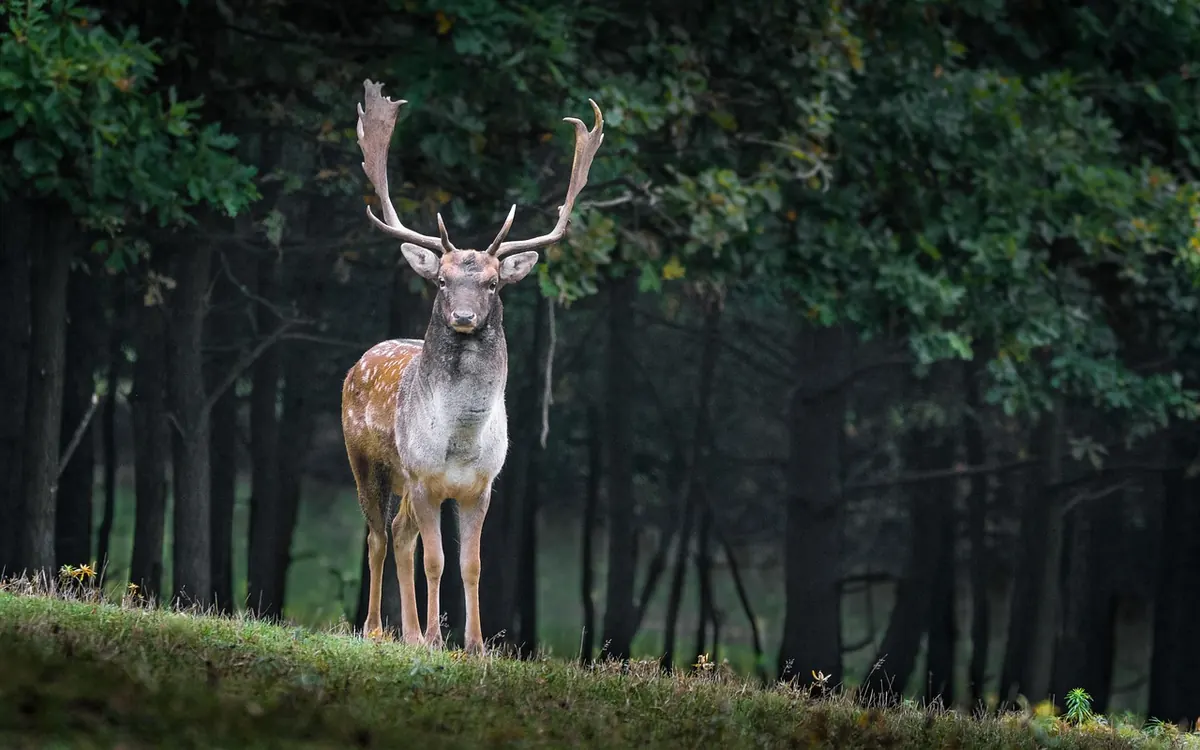
In temperate European woods the crepuscular list is long: roe and fallow deer, badgers, foxes, brown hares, rabbits, wild boar, hedgehogs, woodcock, bats, and owls that call heavily at both ends of the night. Add the moths, midges and beetles that feed half that list and you have most of the wood's traffic.
Treat the label as a tendency, though, not a rule. Deer that step out at dusk in March may be strictly nocturnal in July, when long evenings and dog walkers push them deep into cover. In hard winter weather the same animals will feed in the open at midday. Fog, drizzle and a flat grey sky can stretch a twenty-minute window into something closer to an hour.
Two Twilights, Not One
Dawn is usually the coldest hour of the twenty-four, arriving with still, damp air and dew on everything. Scent lies close to the ground. Sound carries further than you expect. Birds treat it as a roll call: robins first, often well before any light, then blackbirds, song thrushes, wrens and tits building a wall of noise that peaks around sunrise and falls away fast.
Dusk runs on different physics. The ground is still holding heat from the day, warm air lifts off it, and insects rise with the thermals above hedges and track edges. Scent lifts too. Wind often drops as the light goes, then veers. And visibility fails quicker than people plan for — the last twenty minutes before dark are considerably darker than the twenty before that.
Both facts should change how you position yourself. At dusk, stand with the brighter western sky behind the animal, so it shows as a shape, and keep your own body against the dark mass of the trees. At dawn, the light comes to you: anything crossing open ground will be rimmed with it, which is why a dawn watch on a ride or clearing rewards patience so well.
Dawn: The Cautious Shift
Animals that have been feeding in the open all night are thinking about getting back to cover. Roe deer drift back towards thickets, hares and rabbits head for their forms and buries, and everything is hungry after the cold hours. That combination — tired, full, heading home — makes for short, predictable movements you can position yourself for.
Scent conditions favour the watcher at dawn. Cold, damp air holds smell down instead of lifting it to a nose on the wind, and wet grass and leaves are far quieter underfoot than the dry, frosty litter of autumn. Birds are noisy and preoccupied with territory, which covers small mistakes.
The cost is the alarm clock. To watch dawn properly you need to be in position forty-five minutes to an hour before sunrise, which means walking in by torchlight and then sitting still while your eyes adjust. That last half hour of darkness is when most people give up and go home, and it is often the best of the morning.
Dusk: The Hungry Shift
Dusk runs in the opposite direction. Animals are waking up hungry rather than going to bed full: badgers emerge and head out along familiar runs, foxes begin their rounds, bats drop from roosts to hunt the insect hatch, hedgehogs and boar start rooting. It is a shift of appetites, and appetites make animals careless in short bursts.
Sound changes too. The dawn chorus gives way to something sparser and more useful — contact calls between badger cubs, the sharp alarm of a blackbird, the low roding flight of a woodcock over a clearing in spring, tawny owls starting up as the light fails. A few songsters, robins and blackbirds among them, sing again at dusk, and hearing the same voice in a different register is one of the quiet pleasures of watching both ends of a day.
For most people dusk is the easier shift to keep: no alarm, no walking in blind, and you can leave when the light actually goes. The trade is that you are usually watching animals that are already moving away from you into the dark.
Reading the Wood for Which Shift Is Running
You do not need to see an animal to know when it passes. Spend ten minutes at a junction of tracks and look for evidence of timing.
- Browsing lines. Roe deer nip shoots at a consistent height; a neat, nibbled shelf along bramble and honeysuckle tells you where they have been feeding, and how recently the ends have dried.
- Tracks in soft ground. Fresh slots at a gateway after a wet night mean animals crossed in the dark or at first light; if you find them on the way in at dusk, they are from the previous night.
- Droppings and latrines. Badgers use fixed pits; fox scats appear on stumps and path edges. Colour and texture tell you age far better than a guess.
- Hair on wire. A strand caught on barbed wire or squeezed through a gap in a hedge is a reliable sign of a regular crossing point.
- Sound. Alarm calls and contact calls give you a running commentary. Sit still and let a blackbird tell you something is coming long before you see it.
Planning a Dawn Watch and a Dusk Watch
Dawn, step by step
- Check the sunrise time and subtract an hour; that is when you want to be walking in, not arriving at the gate.
- Pick a route you already know in daylight. Walking unfamiliar ground by torchlight is how ankles get turned.
- Choose a position with the light behind the open ground and the wind in your face or across it.
- Sit still through the grey half hour. Movement, not silhouette, is what gives you away.
- Stay put for forty minutes after sunrise. Many animals move again once the sun is up and the wood has settled.
Dusk, step by step
- Arrive at least ninety minutes before sunset and walk the ground while you can still see it.
- Mark your exit route — a path junction, a fence corner — so you are not searching for it in the dark.
- Face the brighter sky and let animals show as shapes against it.
- Listen rather than scan after the light has gone; bats, owls and badger cubs announce themselves.
- Leave before full dark. You will see less, and you will disturb more.
Before You Set the Alarm
Whichever shift you choose, keep the disturbance small. Stay on paths and rides rather than pushing into cover, where a bedded deer or a badger sett will not forgive the intrusion. Keep the wind in your face, wear dull colours, and use a red filter on a torch if you need light at all — a full white beam at a dusk watch empties a clearing. Leave the dog at home. If you are walking unfamiliar ground in the dark, take a headtorch, a charged phone and tell someone your route and return time.
And give it more than one go. A single blank dawn proves nothing; animals move with weather, moon and season, and the watcher who learns one wood over a month of mornings or evenings will always beat the visitor who tries both once and picks a favourite from a coin toss.
Photo: LubosHouska / Pixabay

Green Wood vs Dry Wood for Carving: What Beginners Should Know
Green wood carves like butter but moves as it dries; seasoned wood holds detail but fights the blade. Here...

How to Make a Twig Star: A 20-Minute Nature Craft
A quick, reliable method for turning gathered twigs and garden string into a six-pointed star, plus how to...
About Us